


Give Yourself the Gift of Entertainment
SPIRAL'S PRELUDE:
Duke Ellington's Jump For Joy and Black, Brown and Biege are playing on the juke box. Be-bop has emerged. Ella Fitzgerald is about to embark on her solo career. Outside the pet dog lounges on the front porch. The sun is high and fish is frying in the kitchen. It's the 1940s. Children play in the street. Car horns honk on the other side of town. Shopping malls have not yet been thought of. The day stretches out long. Chores are plenty and arduous. Yet, life seems simple. It is a time of great change and this town is called Greasy Plank.
Welcome . . . . Pull up a chair . . . Come on in . . . .

Listen to Denise read from Spiral
She closed her eyes and breathed deeply. She had inherited this quiet disease from her mother.
PART I
Chapter One
The summer of 1934 was an unusual summer in Louisville, Kentucky. It was the summer children became scared to go outside and play. Although they never said a word, not even amongst each other, the children knew through the many warnings their parents gave them something more fierce, dreadful and evil than ghosts, goblins and imaginary monsters was outside . . . maybe at the park, just around the corner from their family home, perhaps at the edge of the school yard. . . .
"Come 'ere, little girl," a wiry, middle-aged man said while he curled his finger. "Come on, now. I ain't gonna hurt you. I know you're going home from school. It's a long way. Come on with me. I'll give you a ride home so you don't have to walk all that long way."
The freckle-faced girl grinned shyly at the man who was leaning out of the side of a rusty, old pick-up truck smiling and winking at her. A moment later, the little girl sat on the passenger seat with the man. She giggled each time he reached over and tickled her. In between a burst of laughter, the girl looked up at the man and asked, "What's your name?"
PART II
Chapter Two
It was four years later -- August 21, 1938. Tammy Tilson moaned, "God, help me," as she made her way from her bedroom to the bathroom. "Oh, God help me. Everything in front of her was blurry. She closed her eyes and breathed deeply. She inherited this quiet disease from her mother. The mounting stress in her life was only helping to insure that she would die young. "Oh, God," she whispered while she neared the bathroom, "Who killed that little girl?"
It started yesterday evening when the news aired. Tammy had been in the kitchen cooking when she heard, "News Flash." She turned away from the stove and turned the radio up. "All of Memphis, a little girl is missing. The little girl was outside playing in front of her parents home on Monroe Street when neighbors say they saw a man pick her up in a truck. Before the little girl's neighbors could race to the girl's rescue, the man grabbed her and sped down the street. The little girl hasn't been seen since. . . "
That was last night. Now it was early morning, and men were still being ordered from their homes or right off the street to report to the police precinct. There, angry police officers lobbed a series of questions at them in loud, threatening voices. "Where were you last night? I didn't ask you where you were in the morning, you moron. Don't wanna hear another word about morning. Damn it! I'm asking you where you were between the hours of ten and eleven last night! You work? You got a job? Got your own car? Did you drive that car last night? Where'd you go? For how long? Were you gambling last night, boy? Were you out late last night, boy? Where were you?"
The possible answers to the questions only brought more questions to Tammy. After all, her husband, Philip, was one of the men rounded up early this morning. He told her he had been working at their grocery store when cops came down to the store, their car sirens spinning and blaring, grabbed him by the back of his neck and snapped a pair of tight handcuffs around his wrist. They drove him to the police precinct and questioned him for five long hours.
Tammy glanced at a clock on the wall. It was six o'lock in the morning and her husband had only been home for two hours. Tammy went into the bathroom, closed to the door and sat on the toilet with her head between her knees. Life had never been easy for her. She had grown up the daughter of a woman who took ill with bad pressure when Tammy was only seven years old. Tammy couldn't remember a time when her mother played with her or spent longer than two hours out of bed. Oldest of her eleven siblings, from the age of seven, Tammy grew up taking charge and working as hard around the house and on her family's farm as a grown man. Even now she couldn't remember a time when she wasn't working. Not until she was grown and married did the hard work bring a reward. She and her husband were the first Blacks in Memphis to open their own business at the center of town, a place usually reserved for companies owned by wealthy entrepreneurs and adult children of former politicians who hadn't outgrown riding their father's coattails. They were the first people in town to go door to door asking for signatures to sign a petition to have mysterious house fires on the poor side of town fully investigated. They stood up to the mayor when he told them, "y'all ought to be grateful folks support y'all and allow yaw to thrive in these parts. Truth be told, in a lesser town, y'all would've long been dead . . . shot or something another."
Even now she couldn't remember a time when she wasn't working
After she sat on the toilet with her head between her knees for a few minutes, Tammy raised her head and stared out the window. She thought about her husband. He was good to her and their four children. She knew she was the only person he trusted. All his life he made-do and kept his deepest thoughts to himself. He was like a locked door that would only open for her. If not for her, he wouldn't have told a soul he was the one who came upon his mother hanging from the barn loft. He was only six years old. All he knew to do was scream and run. Mothers didn't kill themselves, he told himself while he ran to tell his father to hurry and get his mother down from the top of the barn. His mother wasn't dead. She was just swinging in the air. It was all so easy to believe until his father raced back to the barn with him. The tortured look on his father's face and the hard groans moving up out of his father's mouth made him step back and hide behind his father's thick legs. After he told Tammy the story when they were first married, he never said the words 'my mother' again. To Tammy it was as if her husband had no mother. It was as if he was born straight out of his father's rib.
Seconds later, when Tammy heard her daughters talking in their bedroom, she stopped recalling the past, stood from the toilet and washed her face. She'd keep moving. She'd stand with her shoulders heightened and walk like she didn't fear anything. For her children, she would.
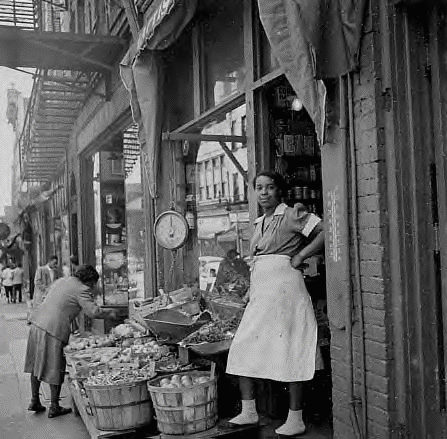
She was the one who talked Philip into purchasing the large grocery store they bought seventeen years ago.
"It's gonna be all right," she repeated to herself until she entered her bedroom and saw her husband, Philip, wrestling in his sleep. Her husband had never been in trouble with the law. The cops had no right to embarrass him in front of their customers, handcuff him and force him to go with them to the precinct, a place where justice was never allowed for the poor or Blacks. While Tammy watched Philip try to sleep, she thought back to their first grocery store. If not for the store, her husband and she would just be farmers who would never break even despite how many hours a day they worked. She almost smiled. She was the one who talked Philip into purchasing the large grocery store they bought seventeen years ago. She didn't even argue when he demanded that the store be named after his kin. Two weeks later the store was torched and burned to the ground. Tammy ran after the hooded men in the trucks and two police cars as they laughed and cursed their way back down the street, away from the burning store. You bastards! God'll get you for this! God'll get you for this!" Sheshouted while she threw heavy rocks at the trucks and cars. She didn't stop throwing rocks until she heard one of the car windows shatter.
"We'll get another store," Philip told her that night while he sat next to her on the front porch cradling a shotgun in his lap.
"Do you know how much money we are out? Insurance company ain't gonna give us no money for the store. They'll say it was our fault the store burned to the ground."
"I know. I know." He reached out and tapped her hand. "We'll build a new store. And if those ignorant asses burn this one down, they're gonna get a load of what's in this here shotgun."
With the help of men in the community, they did build another store, nearly twice the size of the first one. The grand opening of Tilsons Grocery Store in Greasy Plank, a small town in Memphis, Tennessee's Shelby County, was the first story on the cover of Memphis Prize, the city's only Black newspaper at the turn of the century.
Most houses in Greasy Plank were small, wood structures. Most women in the town still pushed their laundry up and down splintered, wood boards before they dipped the laundry in a tin pail of soap and water and hung the clothes on the line in the back yard. Roads were narrow and seemed to stretch for miles with there not being many businesses or shops nearby. Greasy Plank was country, a place where grass, dirt and weeds ruled over brick, mortar and concrete. The closest highway to Greasy Plank was twenty miles from the town. Strangers didn't stay in the town long. Old timers ran them out with hard stares and bitter gossip. It was a town that consisted of the memberships of four churches, New Mount Holly, the church the Tilsons attended, being largest of the four. Everyone in Greasy Plank went to church. Children from the town grew up and married former classmates. Adults stayed in the town until they died. The biggest business in town was Tilsons Grocery Store. More customers shopped at Tilsons than made deposits and withdrawals at the bank, visited the theatre or went shoe shopping on Beale Street.
Every night, with a loaded shotgun nearby, Philip and Tammy cleaned out the grocery store cash registers and counted money customers exchanged for clothing, meat and produce. Tammy placed the money inside a tin box beneath their bed. Monday, she climbed inside the family truck and drove through the business districts paying invoices. Other revenue remained locked in the tin box until she had time to get uptown to Beale Street to Shant's Savings & Trust Company and deposit the money in Philip and her account. Winter Tammy didn't go to the bank; instead, Philip and she gave money to the poor. Within the last month, twice, after the police chief refused to investigate a series of house fires, they lent two neighborhood families money to rebuild homes nightriders burned to ash. They also donated a large sum of money to a home for retarded children. Every donation they made was in the memory of a little girl named Bobbie Long. "Keep this quiet," Tammy always asked when she dropped the checks off.
She put volume in her voice and said, "Trace the root!"
Tammy turned and watched Philip run his hand across his face. She reached out and stroked his back until she felt his muscles relax. "Mama warned me," she whispered while she rubbed her husband's back. "Mama warned me a day like this would come." She sighed. The first seer in the family that's what her mama was. She saw things happen long before they ever did. She went around trying to warn people. "That's what so hard about bein' a seer," she told Tammy, yet a little girl then. "When don't nobody else see what you be seein', folk go 'round callin' you crazy. Seers get they root off family trees, Tammy. Trace the root!" She put volume in her voice and said, "Trace the root!" All those years ago as a small girl, Tammy shook while she watched her mother's eyes roll in her head. Then she watched her mother press her head into her bed pillow, cough and wipe spots of blood away from the edges of her mouth. "Be careful who you let be on our family tree, Tammy. I done tol' ya. I done tol' ya. If you don't, gurl, yous gonna help birth a thing called crazy. Yes. Yes." Then her mother closed her eyes and died.
Shaking thoughts of her mother further into her memory, Tammy sat erect and reminded herself how much work had to be done. A man was coming by the store at one o'clock. He telephoned from Louisville, Kentucky yesterday morning. He told Philip he peddled written works for a living, particularly essays authored by Carter G. Woodson and Frederick Douglass, and thought Tammy and he could sell the books and pamphlets. Tammy argued and shouted with Philip for a whole ten minutes when he told her about the man. "You don't even know who that man is," she said. "We can't afford to go around trusting people, especially people we don't know, Philip. How many business people were calling us before we made a success of the store? Wasn't nobody coming around here before. Since we opened the store all kinds of people knocking on our door. People want to take a free ride on our name. That ain't happening. Nobody wants to see us win, Philip. Nobody. Every single prominent man right here in town wants to see us fall. No," she added shaking her head. "We don't need no outsiders coming around to stir the pot." When Philip responded to her with silence, she lowered her voice. "I just want us to have what we built together stay between the two of us. We did this together, Honey. It's ours, our children's and our grandchildren's, right on down the line." When he smiled at her, she reached out and took his hand inside hers.
"Mama?"
Tammy rubbed her husband's back one last time, then she pushed off the bed and walked into the hallway and looked inside her son's bedroom. "What, Son?" She looked at the closed curtains and sniffed the musty odor cramming the bedroom. "Please open those curtains and windows."
David pushed the curtains apart.
She stood akimbo. "I'm waiting."
In one jerk, he finished parting the curtains and pushed the windows up. The lines in his forehead deepened since his mother entered the room. "Mama, I'm doing the best I can."
"I'm not talking about the curtains. What do you want?"
"Nothing. Never mind."
"Child, what all has been going on with you lately? Don't you know I've got enough on my mind as it is? I don't need you adding to my troubles." She went out of the room then she turned back and entered it again. "And if you think you're grown enough to come creeping in here any ol' time you feel like it, you best do some more thinking. I know you were out late last night. Don't think I don't know." She looked at him with a pointed brow. "Ain't nothing out late at night but trouble. Make sure you're in early from now on. Things are happening around here. Be in early from now on. Only fools stay out late at night." She mumbled. "Sixteen years old." Then she shook her head, turned and went downstairs.
David scowled.
At his side, his younger brother, Jonathan, sat up. His hair was disheveled, his face amuck.
Peering over his shoulder and looking at his brother, David mumbled, "Lay on back down, Jon."
"Who were you talking to?"
"Mama, and so what?"
"I just asked."
Silence.
Jonathan gazed at his brother. "In a funk?"
David was silent. If he had to describe his feelings for his mother, he would say, "I love her. I hate her." His mother had always been hardest on him. These last few months he heaped his greatest disappointment upon her. He fell in love with a girl by the name of Margaret Armstrong, the daughter of a man his mother hated.
Jonathan looked over his shoulder at David. "Mama?"
David lowered his head into his hands. "She's my mother. I'm supposed to love her." His jaw flinched. "I'm trying so hard to do that."
"You still leaving?"
"I don't know." He sighed. "I want to. That's the only way I'm ever going to learn to love Mama. I have to leave."
"Life ain't no fun when you live it full of regret, Man."
David was silent.
"Everybody up! I'm cooking breakfast! If you're not down here soon, you won't eat!"
"So long as you're living, don't you ever tell one soul what you saw. If you tell it, these backwards cops'll only think you did it."
Philip jammed the pillow over his ears. He felt nauseous and thought about running into the bathroom to vomit. Glancing at the small, rotary clock on the nightstand, he saw it was 6:15. His eyelids felt like they weighed two pounds each. If he had left the store when he normally did, the cops would have never cuffed him. He'd have been home, and he knew no one wanted to confront him and his wife when they were together. His wife knew the law and would sue, but him – alone, all he could do was argue and plead for more time to set things straight. He'd been at the store late because one of the regular customers was shaking so badly when he came by the store last night Philip felt he had no choice except to stay with him. Philip listened while the customer talked about seeing a group of men climb out of a truck up on the railroad tracks. While his eyes ballooned, the customer swore to Philip that he saw the men dump a body into the river that ran just over the cliff at the back of the tracks. "Keep it to yourself," Philip coached the customer. "So long as you're living, don't you ever tell one soul what you saw. If you tell it, these backwards cops'll only think you did it, and you'll be the one to end up in jail or swinging from some tree with your neck broke out in the middle of nowhere."
Pushing off the bed, Philip swallowed rising vomit until it burned in his throat.
Down the hall, his oldest daughter, Melinda, hurried out of the bathroom. "Janice, you ready to go downstairs?"
Her twin sister Janice stood behind the bedroom door so her brothers wouldn't see her snapping her bra closed. "Yes. Mama said we have a lot of work to do today."
"We always have a lot of work to do."
Her bra fastened, she tossed Melinda a pair of wool gloves. "Here. Catch."
A vase of yellow tulips decorated the center of the large newly hewn table. The flowers seemed like a decoy, a sign of how much effort Tammy was putting into convincing her family that everything was all right. Above the flowers, sunrays came through the windows with a strong glare, and yet an ominous foreboding pointed at the family.
SPIRAL -- Become a part of the Victory For Truth, Justice and Freedom!
Leave your troubles behind. Just let go and venture back in time. . . . SPIRAL
Place your order for Spiral by clicking
Buy Now
Order Spiral now and get FREE Priority Mail Shipping

Back Home Enjoy Spiral Enjoy Portia Enjoy Love Has Many Faces Chistell Publishing
Learn and have fun while you explore more of our site!
We love it when you stop by!
Visit us again real soon!


No portion of this women's books, book reviews, multicultural or african american web site may
be reproduced in any form without the expressed, written permission of the site owner.
Privacy Policy: We value your privacy. We do not store or sell personal data.
This website designed by affordablewebsites.net a BBB Accredited Company


